Views: 0 Author: Site Editor Publish Time: 2026-01-14 Origin: Site
If you’re wondering what is the joist spacing for composite decking, most manufacturers recommend 16 inches on-center for standard installations. However, if you’re installing the boards diagonally, the answer to what is the joist spacing for composite decking is often 12 inches on-center. Some specialty composite boards allow for joist spacing up to 24 inches, but always check the manufacturer’s guidelines. Using the correct joist spacing for composite decking is crucial for safety and durability. If you don’t follow the recommended spacing, your deck could sag, bend, or even break. Refer to the table below to see how what is the joist spacing for composite decking affects safety and the lifespan of your deck:
Aspect | Impact on Safety and Lifespan |
|---|---|
Load-Bearing Capacity | Incorrect joist spacing for composite decking reduces strength and can cause breaks. |
Structural Integrity | Poor spacing affects the stability of the deck. |
Deflection and Failure Risk | Too wide joist spacing for composite decking can make boards bend excessively. |
Compliance with Codes | Following the right joist spacing for composite decking ensures safety and longevity. |
Use 16 inches on-center spacing for most composite decking. This helps give the boards enough support. If you lay the boards diagonally, use 12 inches on-center spacing. This stops the boards from sagging and keeps them strong. Some reinforced boards can have spacing up to 24 inches. But you should always check the manufacturer's guidelines first. Using the right joist spacing is very important for safety. It also stops sagging and keeps the deck strong. Always read the installation manual. This keeps your warranty safe and helps you avoid mistakes that cost money.
When you ask what is the joist spacing for composite decking, you find that most brands recommend 16 inches on-center for straight layouts. This means you measure from the center of one joist to the center of the next. You use this measurement to make sure your deck boards have enough support. If you plan to lay your boards diagonally, you need to use 12-inch spacing. This closer spacing helps prevent sagging because diagonal boards span a longer distance between joists.
You may see some boards, like MAX or reinforced types, that allow up to 24 inches on-center. These boards have extra strength built in. Always check the instructions for your specific composite decking before you start. Some boards need more support, especially if you want to add heavy items like hot tubs or planters.
Here is a quick list to help you remember the most common measurements for what is the joist spacing for composite decking:
16 inches on-center for straight installations
12 inches on-center for diagonal patterns or heavy loads
Up to 24 inches on-center for special MAX boards
You can see how these measurements compare in the table below:
Decking Type | Recommended Joist Spacing |
|---|---|
Composite Decking | 12 inches (diagonal) / 16 inches (straight) |
Wood Decking | 16 inches |
Composite decking often needs closer joist spacing than wood. This is because composite boards can flex more than wood boards.
Different brands have their own rules for what is the joist spacing for composite decking. You should always read the manufacturer’s guide before you build. Some brands, like Trex, TimberTech, and AZEK, use the same spacing for straight and diagonal patterns as the standard. Others, like WearDeck, let you use wider spacing if you use their reinforced boards.
Here is a table that shows how some popular brands set their joist spacing:
Brand | Straight Spacing | Diagonal Spacing | Notes |
|---|---|---|---|
Trex | 16 in. OC | 12 in. OC | Standard across all collections |
TimberTech and AZEK | 16 in. OC | 12 in. OC | MAX boards allow extended spans |
WearDeck | 24 in. OC | 16 in. OC | Only for reinforced boards |
The pattern you choose for your deck also changes what is the joist spacing for composite decking. If you want a herringbone or diagonal pattern, you must use 12-inch spacing. This keeps your deck strong and safe. The table below shows how installation patterns affect joist spacing:
Installation Pattern | Recommended Joist Spacing |
|---|---|
Diagonal | 12" on-center |
Straight-lay | 16" on-center |
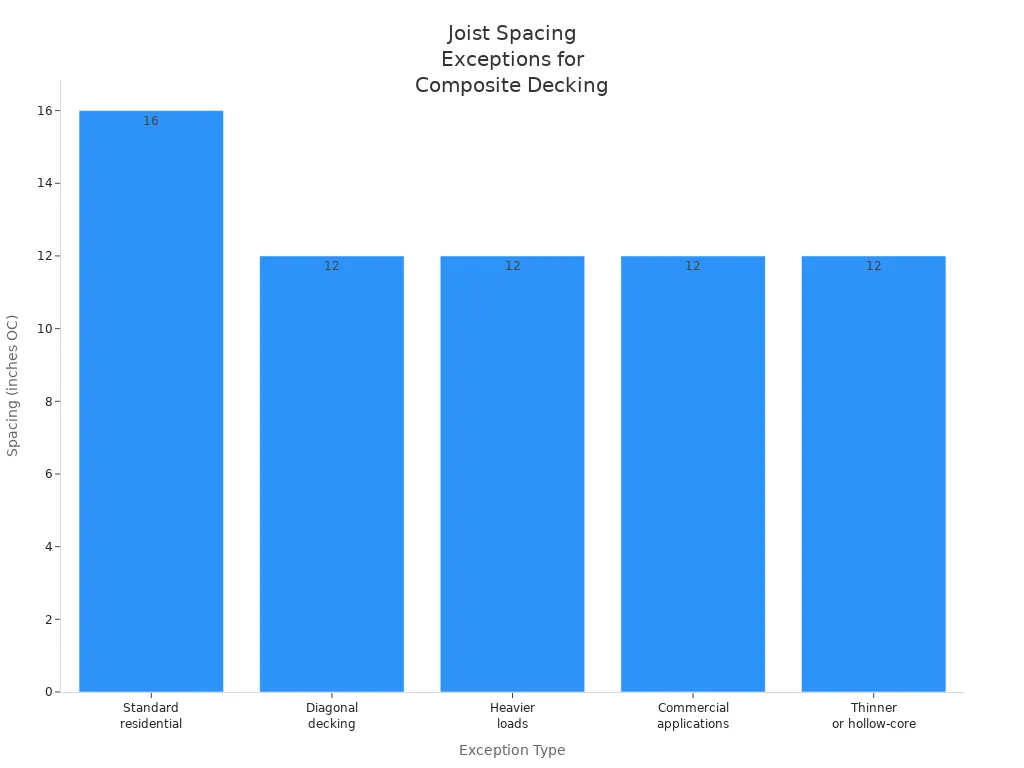
Some situations need even closer spacing. If you plan to put heavy items on your deck, or if you use thinner or hollow-core boards, you should use 12-inch spacing. Commercial decks also need this closer spacing for safety. Here is a chart that shows exceptions to standard joist spacing:
Tip: Always check the installation manual for your composite decking. Manufacturers may require certain joist spacing to keep your warranty valid.
You can see that what is the joist spacing for composite decking depends on the brand, the pattern, and how you plan to use your deck. If you follow these guidelines, you will build a deck that lasts for years.
You want your deck to feel solid and safe every time you step outside. Proper deck joist spacing gives your composite decking the support it needs. When you follow the right joist spacing, you prevent weak spots and keep the boards from moving or bouncing. If you use the standard 16-inch spacing for most decks, you get enough support for daily use. For heavier loads or thinner boards, you should use 12-inch spacing. This closer joist layout helps your deck handle more weight and keeps it strong for years.
Here’s how proper joist spacing helps your deck:
It prevents sagging and keeps your deck flat.
It gives your deck the strength to hold people, furniture, and grills.
It reduces the risk of boards bending or breaking.
If you ignore the recommended joist spacing, you might see problems like sagging boards, bouncy surfaces, or even waves in your deck. These issues can make your deck unsafe.
Risk Type | Description |
|---|---|
Sagging boards | Boards may sag in the middle of the span. |
Movement or bounce | Deck may feel bouncy when walked on. |
Waves or unevenness | Over time, the deck may develop undulation. |
Sagging is one of the most common problems when you do not use the right deck joist spacing. If the joists are too far apart, the boards do not have enough support. This can lead to a weak or sagging deck surface, trip risks, and even structural instability. You can prevent these problems by following the manufacturer’s joist spacing guidelines.
Sometimes, you need extra support in high-traffic areas or under seams. You can add double joists in these spots to keep your deck strong and level. Moisture and airflow can also affect your deck over time, so proper joist spacing helps protect against these issues.
You want your deck to last, and you want to keep your warranty. Most manufacturers require you to follow their joist spacing instructions. If you do not, you could void your warranty. Not following the right spacing can cause joist deflection, uneven boards, and safety hazards. Manufacturers check for proper installation before they honor any warranty claims. Always read the installation guide and measure your joist spacing carefully. This simple step protects your investment and keeps your deck safe.
Tip: Always double-check your joist spacing before you install your composite decking. This helps you avoid costly mistakes and keeps your warranty valid.
You can measure and lay out joist spacing for your composite decking by following a clear process. Start by setting both the rim joist and the ledger on sawhorses after you cut them to size. Use a tape measure to mark every 16 or 12 inches on each board, depending on your installation pattern. Before you install the ledger board, check that the joists will not hit any wall protrusions or obstacles. This helps you avoid problems during installation.
Here is a simple step-by-step guide:
Place the rim joist and ledger on sawhorses.
Cut both boards to the correct length.
Use a tape measure to mark your joist spacing (12, 16, or 24 inches on-center).
Mark lines on the ledger board for each joist and add an "X" to show where you will install each one.
Double-check that your joist layout matches your installation guide.
Tip: Always pull your measurements from the same spot to keep your joist spacing consistent.
You need the right tools and materials to install joists correctly. Here is a list to help you get started:
Tape measure
Carpenter’s pencil or chalk line
Speed square
Sawhorses
Circular saw or miter saw
Joist hangers
Fasteners (screws or nails)
Level
Safety gear (gloves, goggles)
You should gather all these items before you begin installing joists. This makes the installation smoother and helps you avoid delays.
Many DIYers make mistakes when measuring and laying out joist spacing. You can avoid these errors by learning what to watch for:
Ignoring the manufacturer’s installation guide. This can void your warranty and cause problems with your deck.
Not allowing for wood movement. Wood expands and contracts, so you need to plan for this to prevent gaps or buckling.
Skipping a dry fit. Laying out your joists before you fasten them helps you spot spacing issues early.
Note: Always follow the installation guide for your composite decking. This keeps your deck safe and your warranty valid.
You can also use a table to remember best practices for marking and maintaining joist spacing:
Step | Description |
|---|---|
1 | Plan joist size, span, and spacing before you start. |
2 | Use on-center measurements for all joists. |
3 | Mark lines and "X" for each joist on the ledger. |
4 | Pull all measurements from the same spot. |
5 | Adjust end joists if needed to fit your decking boards. |
By following these steps and tips, you will install joists with the right spacing and build a strong, safe deck.
You should use the right joist spacing for composite decking. This keeps your deck safe and strong. Always read the manufacturer’s guide before you start. Measure each joist with care. If you make mistakes, boards can sag or become unsafe.
Decking Material | Board Thickness | Joist Size | Recommended Joist Spacing |
|---|---|---|---|
Composite/PVC | 1 in (25 mm) | 2×6 | 12–16 in on-center |
Quick Tips:
Set joists 16 inches apart for most decks.
Make sure joists are level before adding boards.
Add blocking if you need more support.
Good planning and careful measuring help your deck last longer.
Most composite decking needs 16 inches on-center spacing. If you lay boards diagonally, use 12 inches instead. Always look at the manufacturer’s deck frame spacing rules before building.
Only special MAX or reinforced boards can use 24-inch spacing. Regular composite boards need more support and closer spacing. Always read the product instructions before picking your spacing.
Yes, it does. Not using the right spacing can make you lose your warranty. Manufacturers want you to use proper spacing for safety and strength. Always measure well and follow their rules.
You need a tape measure, pencil, speed square, and level. These tools help you mark and check your joist layout. The right tools make your deck safer and easier to build.
Diagonal boards go over a longer space between joists. You need closer spacing, usually 12 inches, to stop sagging and keep your deck strong. Straight boards can use wider spacing.

 English